
Best Practices · 4 min read
Common Feeding Mistakes in Traditional Aquaculture and How to Avoid Them
Five everyday feeding errors that quietly waste feed and money on Indian fish farms, and the simple habits that correct them.
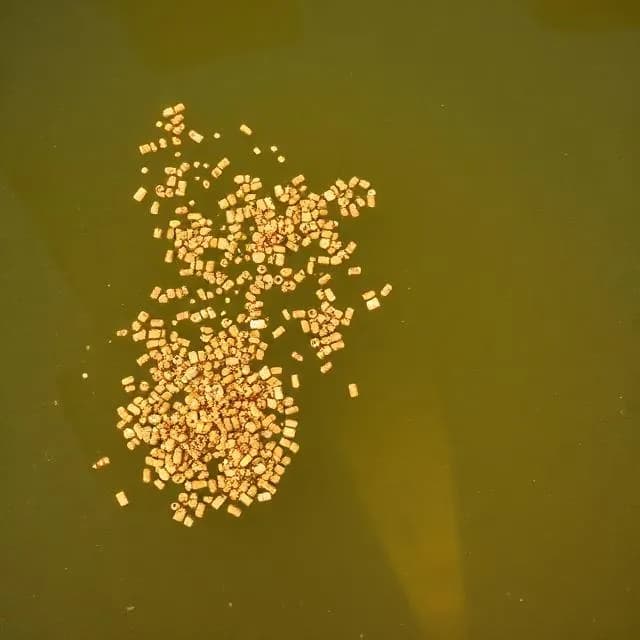
The same feeding mistakes turn up on farms across India, whatever the region or the species. Each one looks small on its own, but over a full culture cycle they add up to wasted feed, slower growth and poorer water. The good news is that none of them needs expensive equipment to fix, only attention to detail and a willingness to adjust.
Mistake 1: Feeding a fixed amount instead of a share of the stock's weight
Many farmers give the same quantity every day for the whole season, say 50 kg a day from stocking to harvest. Early in the cycle, when the fish are small, that is far more than they can eat. Later, when the same fish weigh three times as much, it is far too little. Both ends of the season lose money.
The fix is to feed a percentage of the total fish weight in the pond (the biomass) and to update it as the fish grow. Net a sample every two weeks or so, weigh it, work out the average weight and multiply by the number of fish you believe are alive. A rough biomass estimate is still much better than a fixed ration. Our feed calculator does this arithmetic for you.
Mistake 2: Ignoring water temperature
Fish are cold-blooded, so their appetite and digestion rise and fall with water temperature. In the cold months they simply cannot use a full summer ration. The uneaten feed rots on the pond bottom, spoils the water and stresses the stock. In the warm, comfortable months the opposite happens: farmers who are still feeding a winter ration hold back growth they could have had.
Check the water temperature with a simple pond thermometer and adjust. As a general guide, our feed calculator cuts the ration to about half when the water drops below 22 °C and to about a third below 18 °C, with a single feed a day in very cold water. In the comfortable range for your species, feed the full ration and watch how quickly it is cleared.
Mistake 3: Feeding at the wrong time of day
Dissolved oxygen is at its lowest around dawn, after a night in which plants and algae have used oxygen instead of producing it. Feeding heavily at first light, when fish are already short of oxygen, puts extra strain on them and much of the feed is wasted. At midday in a hot summer, fish move away from the warm surface and floating feed can drift uneaten.
Feed after the sun has been up for a while and oxygen has recovered. In hot weather, move feeding to the cooler morning and late afternoon. Split the day's ration into two to four smaller meals rather than one large one, so the fish can eat and digest it properly and less is left over.
Mistake 4: Using the wrong pellet size
Pellets must suit the size of the fish's mouth. Pellets that are too big are spat out or ignored by small fish. Pellets that are too small make large fish work hard for little food, and more of the fine material is lost to the water.
Follow the size guidance on the bag and move up to larger pellets as the fish grow. A common rule of thumb is a pellet roughly a quarter to a third of the width of the mouth. When you change size, mix the old and new pellets for several days so the fish get used to the change.
Mistake 5: Storing feed badly
Feed loses quality quickly when it is stored badly. Damp leads to mould, heat speeds up the breakdown of vitamins and fats, and rats and insects spoil and contaminate bags. Yet feed is often kept in open bags, in damp corners or in direct sun.
Store feed in a cool, dry, airy room out of the sun, with bags raised off the floor on pallets. Use the oldest bags first. Check each bag for damp, mould, lumps or pests before you open it for the pond, and do not feed anything that smells musty. Buy in quantities you can use well within the shelf life printed on the bag. Good feed that has been badly stored is money wasted, however carefully you work out the ration.
From habit to a simple routine
Correcting these mistakes does not mean a big change to the way you farm. Start with regular sampling and a biomass estimate. Adjust the ration for water temperature. Feed at sensible times and in several smaller meals. Match the pellet to the fish, and look after your feed in storage. Keep a notebook of what you fed and what you saw, so each season you know a little more about your own ponds.
If you would like a second opinion on your feeding routine, the Zoventa team can help by WhatsApp or phone, and the Zoventa Advisor can run the numbers for your stock at any hour. Treat every figure as a starting point and adjust it to what your fish actually eat.